The Velocity Shock: Prototyping with GenAI
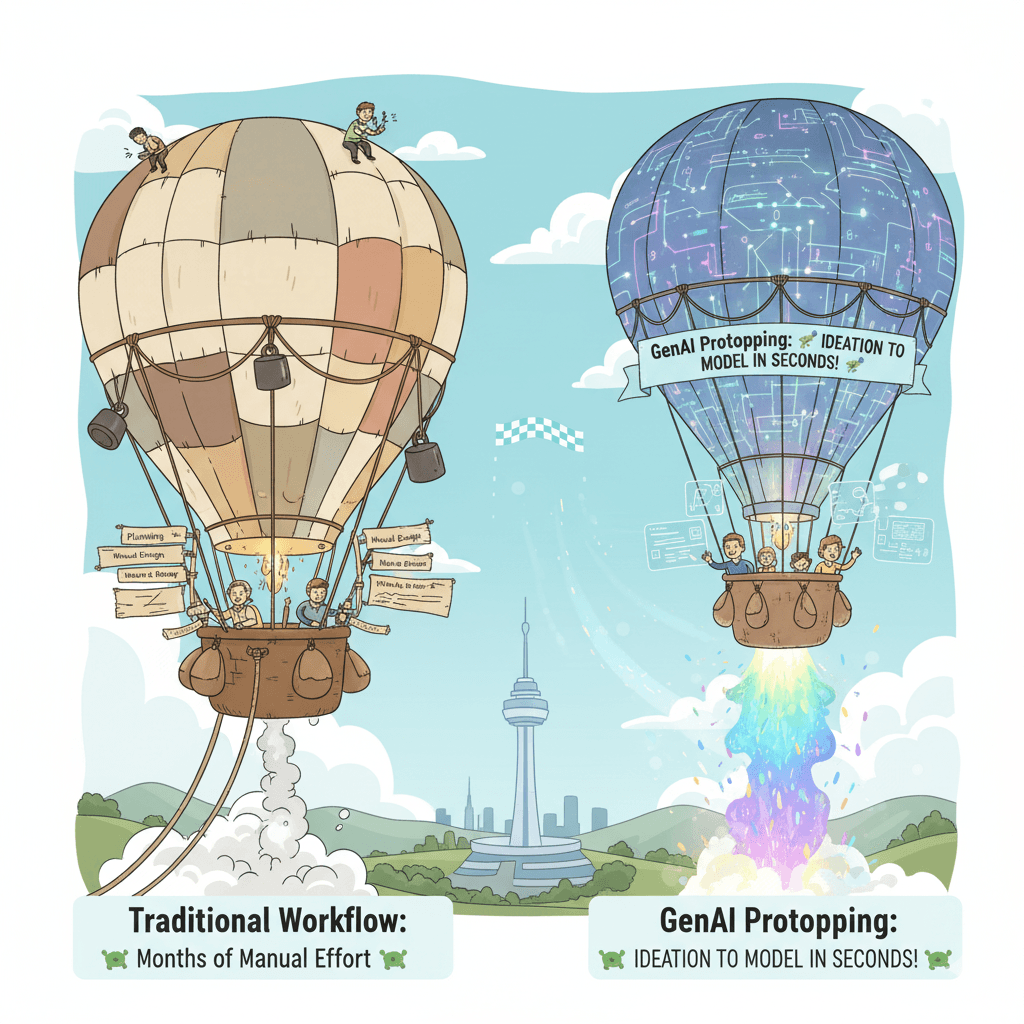
The role of the Product Manager (PM) is being reshaped by the speed of generative AI (GenAI). For decades, product development adhered to some kind of rigid, sequential workflows where you find designers handing off specs to engineering, who built prototypes, which were then reviewed. This process served as a natural speed bump, forcing deliberate thought but often creating frustrating delays.
Today, that friction is vanishing. A fundamental shift in how products are built means AI-native design workflows enable teams to jump from a simple text prompt to a functioning prototype in a matter of hours, rather than weeks.1 High-quality user interfaces (UIs), complete with best practices and basic logic, can be instantly generated from simple texts(isn’t that amazing).1 This acceleration provides immense opportunity for faster iteration and earlier user feedback. However, as much as this speed is glittering it can fundamentally blur the lines of traditional responsibility, forcing a necessary convergence of product, design, and engineering functions. When prototyping an idea involves writing a prompt that instantly produces working code, the traditional handoffs dissipate, take lovable(a very powerful AI tool used for building fullstack web apps) as an example, I built the prototype of a webapp within minutes without going through design-engineering phase. (this is where emerging opportunities come into play).1
The technical community is already grappling with the human consequences of this velocity shock. Consider the "Engineering Dilemma of Juniors".2 If simple tasks are automated by AI, guided by senior engineers, how will new seniors acquire the foundational skills necessary to grow? Conversely, the "Engineering Dilemma of Seniors" raises concerns about burnout, as these experienced leaders spend 90% of their time managing the errors and slicing tasks for AI agents, rather than experiencing the core joy of hands-on technical work.2 The PM is pulled into this operational void, becoming the strategic orchestrator necessary to manage the outputs of these AI agents and integrate them reliably into the broader operations.
Trend Shift: AI-Powered Strategy Becomes the Competitive Necessity
This new operational velocity means that product strategy itself must evolve to keep pace. For product leaders, adopting AI is no longer a forward-looking ambition; it is now an urgent, competitive necessity.3 The market is demanding smarter, faster products, and companies that cannot leverage AI for strategy will inevitably fall behind.
The strategic conversation is moving "From features to revenue".3 Great products are not merely appendages of the business; they actively drive it. The PM’s metric of success must transition from tracking feature output (velocity) to tracking measurable business outcomes (impact). This focus is sharpened by the trend that "Depth over breadth wins".3 With real-time insights and less friction enabled by AI, teams can scale with less effort and move with greater clarity. The goal is to focus intensely on high-impact initiatives, rather than building a wide array of mediocre, low-value features.
The operational foundation for this focus is the rise of the new operating model: AI workflows.3 AI-powered workflow automation is projected to become the backbone of the most agile and effective product organizations by 2025, enabling speed, focus, and impact at scale.3 This shift necessitates identifying repeatable workflows and automating them, standardizing best practices across teams to improve onboarding and scalable product operations.3
Crucially, the rapid output enabled by generative AI introduces a profound strategic risk: Strategy Drift. As the tools accelerate the speed of creation, they also run the risk of generating "safe, derivative designs," effectively raising the baseline for acceptable quality but failing to help teams achieve true differentiation.1 When AI makes it easy for anyone to generate a decent interface, differentiation depends entirely on human vision. This is why a strong Product Point of View (POV) is deemed the explicit antidote to strategy drift.3 The PM’s primary value proposition shifts from managing execution speed to establishing unique strategic direction and injecting the necessary human vision to push beyond AI’s default outputs, thus raising the product’s ceiling of innovation.1
Embracing the Full-Stack Mandate: Product Management in the GenAI Lifecycle
The AI talent shortage remains a substantial challenge, driven by a lack of in-house expertise needed to design, deploy, and maintain complex AI systems.4 The Full-Stack PM must step into this talent gap, mastering the full Generative AI (GenAI) lifecycle and leveraging AI tools to automate specialized expertise.5
The GenAI lifecycle, spanning from inception to continuous improvement, requires holistic oversight.6 It begins with Scoping and Problem Definition, where the business context and clear objectives for the AI solution must be articulated.6 This is followed by Model Selection and Customization, ensuring the chosen AI model is aligned precisely with the application’s goals—for instance, choosing platforms that offer AI Blocks to automatically categorize feedback and assign tasks.5
Perhaps the most critical phase for the PM involves Data Investigation and Preparation. Unlike traditional data science projects, GenAI data preparation requires a specialized step: embedding data into vector store databases for use with Retrieval-Augmented Generation (RAG).7 The PM must understand these technical nuances because architectural choices made early on directly impact later scalability and cost.
This comprehensive technical understanding is a necessary response to the operational strain placed on senior engineers. By mastering the GenAI lifecycle and effectively slicing the strategic vision into technically achievable, cost-conscious tasks, the Full-Stack PM shoulders the burden of strategic guidance. This mitigates the risk of technical fatigue among senior staff and ensures that the accelerated outputs from AI agents are effectively integrated into scalable, well-governed operations, fulfilling the mandate of the future product organization.2